
Treating Depression in adults with ADHD where it actually lives: In Relationships
An introductory course in interpersonal psychotherapy for therapists working with the most underserved and under-treated populations in mental health.
Developed by Certified IPT clinicians and one of Canada's leading ADHD Psychotherapists. Eligible for CE hours. Certificate issued on completion.
Adults with  ADHD and depression are some of the most treatment-burdened people clinicians see. They carry a diagnosis history that grew from years of being called resistant, dramatic or non-compliant. They show up motivated, forget their appointments, reconnect hard, and then disengage again just when momentum was building. They are not failing therapy. Therapy, as it was designed, was not built around how their nervous system actually works.
Interpersonal psychotherapy (IPT) has always been at it's core, one of the most ADHD-friendly frameworks available. It is relational rather than cognitive. It is here-and-now focused rather than historical. It gives structure to something that feels deeply overwhelming, and it builds skills that compound long after the session ends.
This course will show you why that fit is not accidental, and how to make it explicit and intentional in your clinical work.
Your ADHD clients make real progress in session but cannot hold it when they get back into their lives,
You have tried adapting CBT for ADHD and found the protocols get stretched in ways that feel unmoored,
You screen for ADHD in clients presenting with anxiety or depression but are not sure what to do differently once you find it,
You watch clients absorb shame from their relationships and their own histories in ways that generic psychoeducation does not reach,
Your case complexity has outpaced your training and you want clinical confidence, not just vocabulary.

If you are interested in purchasing multiple seats for a group practice or other group setting, please contact us for a discount rate (more than 3 seats).
Most ADHD training for clinicians covers symptom profiles, psychoeducation scripts and accommodation checklists. This course does not.
This is a clinical training that takes you inside a specific evidence-based modality, interpersonal psychotherapy, and shows you exactly how its mechanisms align with the relational, emotional and attentional challenges your ADHD and depression clients bring to your office. You will leave with a framework, not a folder of handouts.
IPT has one of the lowest dropout rates of any psychotherapy modality. It is here-and-now focused, time-limited, structured without being rigid, and it targets relationships rather than cognition. For clients who have spent years being told their problems live in their thinking, that is a fundamentally different clinical experience. And it works.
What you can expect

Stop guessing which disorder to treat first and understand the bidirectional cycle linking executive dysfunction, invalidation and social disconnection to depressive episodes, so you can make more confident, targeted treatment decisions.
Learn how to differentiate between clients already receiving first-line ADHD treatment and those who are not, and adapt your therapeutic role accordingly, without overstepping or underdelivering.
Identify and map rejection sensitivity, emotional impulsivity and role transition to specific IPT focal areas, so your sessions are purposeful, structured and moving toward a concrete goal.
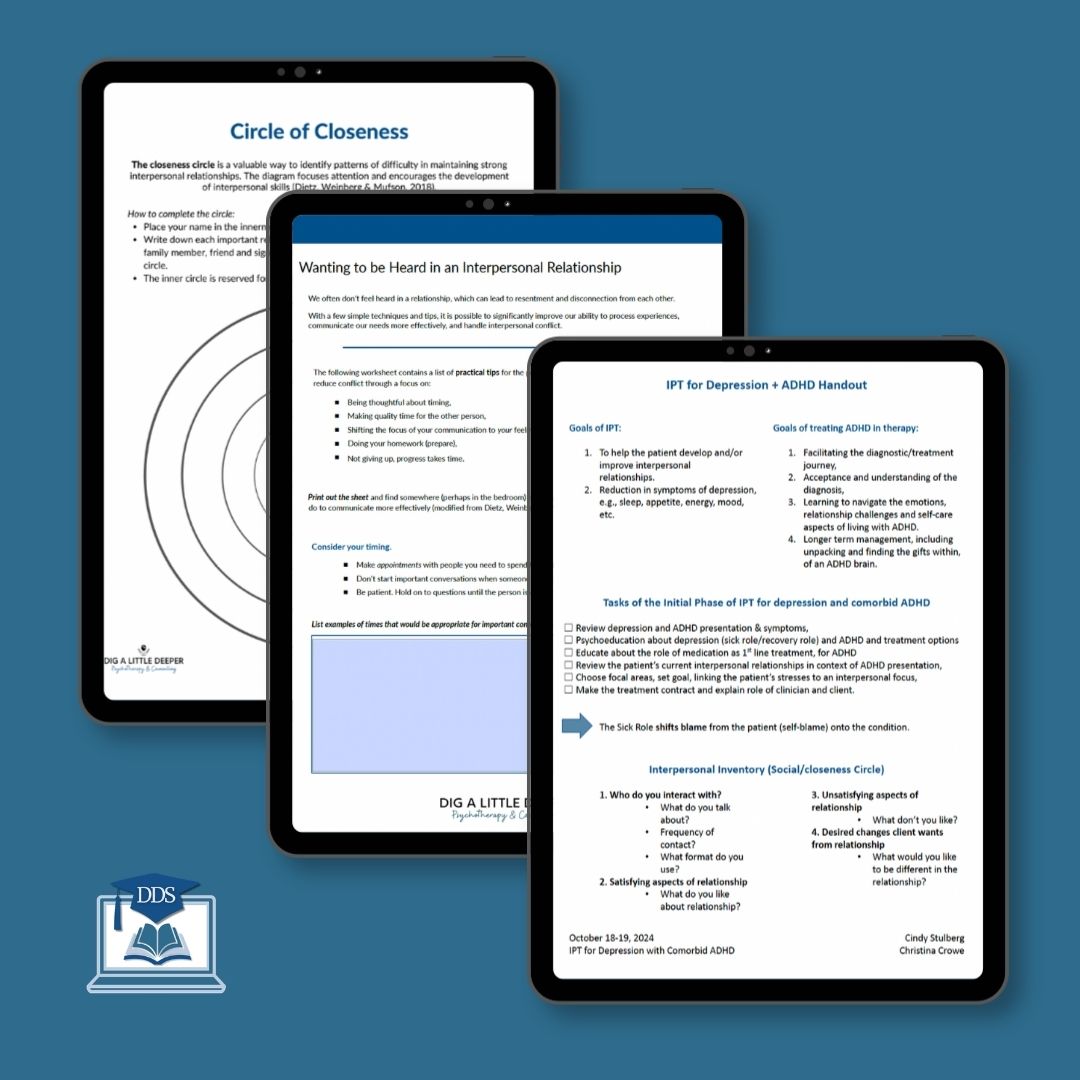
Leave with usable, in-session techniques your clients can apply when their executive function is offline, so the work you do together does not disappear the moment they walk out the door.
Understand when and how handy tools and select AI prompts can scaffold real-time communication for clients, and how to introduce them responsibly without compromising the therapeutic frame.
Offer care that does not over-pathologize the person while still taking the condition seriously. That balance is rare. Your clients will notice it immediately.
Get the kind of case-informed clinical wisdom that does not appear in textbooks yet. This is real practice, shared honestly, and you can apply it the week you finish the course.


Format
Welcome to IPT for Depression and ADHD
Your Trainers
Background
Learning objectives
Introduction to IPT for Depression and ADHD
Lesson overview
Depression in an adult with ADHD
The Current Treatment Landscape
First, do no harm
Lesson overview
An Overview of Interpersonal Therapy (IPT), briefly
Adapting IPT for ADHD brains, Part 1
Adapting IPT for ADHD brains, Part 2
A Case Study
ADHD Friendly Strategies
Key Takeaways and Closing Thoughts
Reference and Resources

Frequently Asked Questions
No. This is an introductory course. It is designed to make IPT accessible and clinically compelling for therapists who are curious about the model, regardless of prior training. If you already have IPT training, this course will deepen your ability to personalize it for ADHD and depressive presentations specifically.
No. If you regularly see adults with depression, anxiety or complex presentations, you are almost certainly seeing undiagnosed or undertreated ADHD. This course will help you recognize and respond to those presentations more effectively regardless of your primary specialty.
Address common questions ahead of time to save yourself an email.
The main module runs just under 2 hours. Resources are downloadable and the course is self-paced, so you can move through it in a single session or across several.
Yes, explicitly. The clinical framing throughout this course treats ADHD as a neurobiological condition that creates real functional challenges, not a character flaw or an excuse. Neurodivergent-affirming care is not about minimizing the hard parts. It is about making sure your clients never feel othered for having a brain that works differently.
You will receive an automatic certificate of completion. You will also have access to information about Cindy's full IPT certification training, which runs twice per year, and ongoing work from Dig A Little Deeper in ADHD-specialized clinical practice, including ADHD in-services, clinical supervision and consultation.

Gain a clear grasp of ADHD medication's role in treatment. Created for psychotherapists, coaches, and counsellors, this course meets competency standards and supports a neurodivergent-affirming approach to collaborative care.

DIY*ADHD: Couples is a clinician-designed course for therapists who work with couples with ADHD in the mix. Learn how executive dysfunction, emotional regulation, and attention challenges affect romantic partnerships, and how to intervene.
This course will change what happens in your sessions the week you finish it.
