.png)
The impact of ADHD can be difficult to identify in the session room due to its heterogeneity.
There is a lot of information (and misinformation!) to sift through, and it can be difficult to know where to turn for credible information. It's also challenging to find therapeutic experts with significant clinical experience. Couple therapists can feel uncertainty about why therapy wasn't helpful for a couple - was it the modality? the couple? the therapist? the setting? They might experience a loss of confidence, and ultimately pull away from helping myriad couples or families that need them.

ADHD is too often missed.
ADHD is missed in couple's therapy largely because it is still significantly under-recognized, under-diagnosed, and under-treated amoung adults globally. A couple with undiagnosed (or diagnosed, but unmanaged) ADHD within the dynamic, has this as a major feature that sets them apart: The reason these couples cannot be treated the same as 'neurotypical' couples is the behaviour of the undiagnosed partner(s) is being largely driven by invisible and involuntary brain function, rather than by choice or trauma.
Reason #1
The heritability of ADHD, combined with the under-diagnosed and under-treated context, means people with ADHD have also been found to be more vulnerable to developmental or childhood and attachment trauma.
Reason #2
Adults with ADHD report less stability in their love relationships, feel less able to provide emotional support to their loved ones, experienced more sexual dysfunction, and have higher divorce rates.
Reason #3
Unmanaged ADHD is a risk factor for dating violence, family violence, infidelity, high conflict divorce, and adults with ADHD report lower marital satisfaction than their non-ADHD peers.

ADHD-adapted Relational Therapy (AART)
ADHD-adapted Relational Therapy (AART) was developed by John Foulkes RP and Christina Crowe RP, an exclusive approach tailored for couples of mixed neurotypes. AaRT integrates neuroscience, ADHD treatment guidelines, executive functioning support, and relationship dynamics with existing couple therapy interventions.
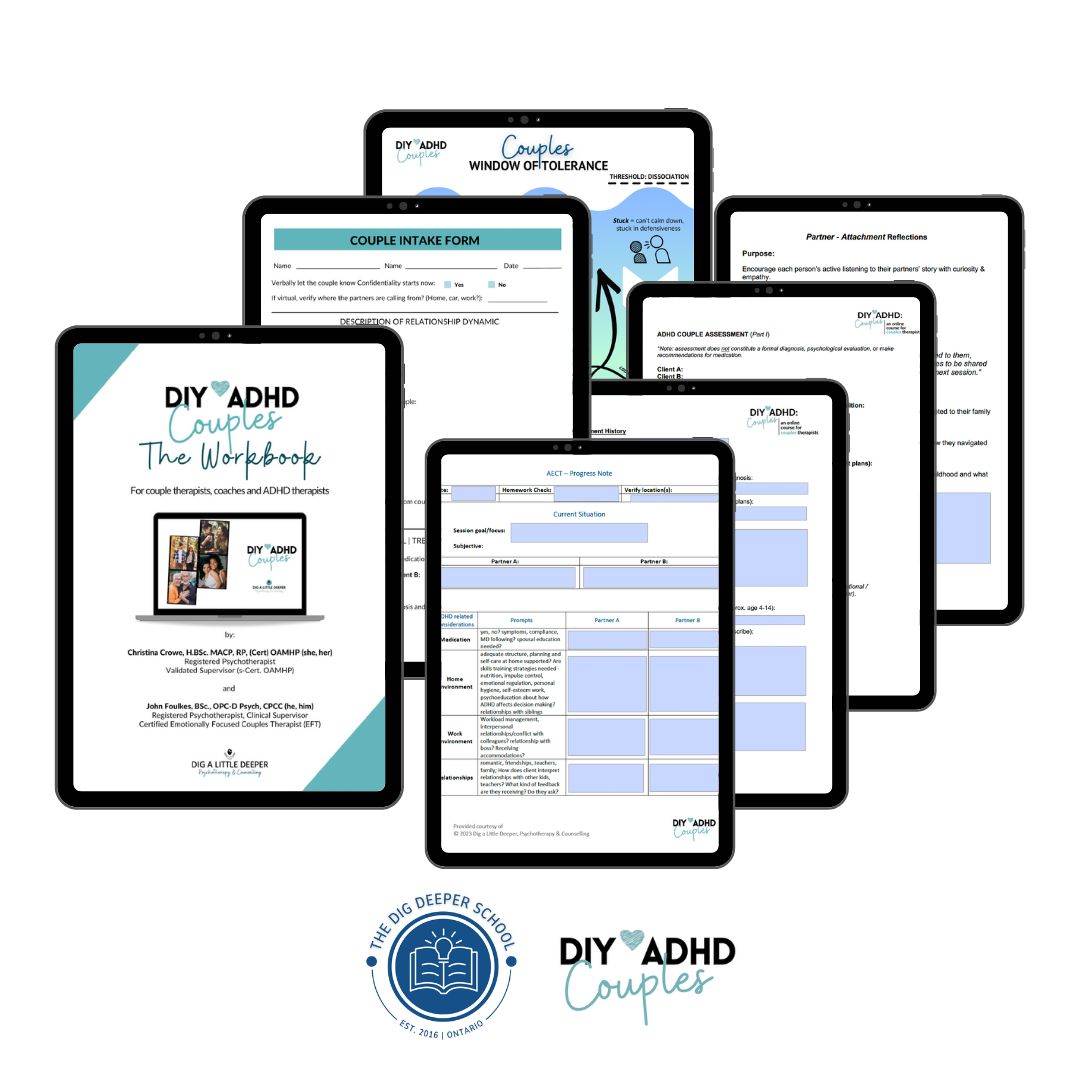
This course allows you to:
Identify
Identify the involuntary brain-driven behaviours commonly challenging the couples therapeutic process,
Integrate
How to integrate relational neurobiology into your chosen couples therapy modality through AECT Model of Practice: ADHD Experiential Couples Therapy.
Coordinate
How to coordinate care with other practitioners confidently,
Hear from Christina & John
There may be no other more misunderstood term than that of 'gaslighting' applied to folks with ADHD. More nuanced education allows you to help your couple clients shift from frustration and misunderstanding to mutual support and connection.
Curriculum
-
1
Section One: Context is everything
-
(Included in full purchase)
Chapter 1: Introduction
-
(Included in full purchase)
Chapter 2: ADHD Defined
-
(Included in full purchase)
Chapter 3: The Science
-
(Included in full purchase)
Chapter 4: Screening and Measuring
-
(Included in full purchase)
Chapter 5: How does ADHD show up in relationships?
-
(Included in full purchase)
Chapter 6: Creating a couple-based treatment plan
-
(Included in full purchase)
-
2
Section Two: The Work
-
(Included in full purchase)
Chapter 7: ADHD Relational Couples Therapy
-
(Included in full purchase)
Chapter 8: Integrating models of practice
-
(Included in full purchase)
Chapter 9: The role of ADHD medication in couples therapy
-
(Included in full purchase)
-
3
Section Three: Important Considerations
-
(Included in full purchase)
Chapter 10: Multi-Disciplinary Care Coordination
-
(Included in full purchase)
Chapter 11: What about you, the couples therapist?
-
(Included in full purchase)
Chapter 12: Conclusion and summary thoughts
-
(Included in full purchase)
-
4
Course Evaluation and Certificate
-
(Included in full purchase)
Please fill out the Evaluation form!
-
(Included in full purchase)
.jpg)
About Christina & John
With over a combined decade and hundreds of clients, John and Christina have put together a course that pulls together the best of the current science, experiential couples modalities and the adaptions that really work for neurodivergent couples. John Foulkes, BSc., OPC-D Psych, CPCC, RP, OVCS, (Cert.) IPT (he, him) is psychodynamically trained and certified in EFT, IPT, Reality/Choice Therapy. John is an EFT Couples Therapist and provides individual and group supervision for Couples therapists. Christina Crowe, MACP, RP, OVCS, CMHP (she, her) is a neurodivergent-affirming Registered Psychotherapist, Certified IPT Therapist and Validated Clinical Supervisor. Christina works with individuals (ages 16+), couples and families.
What therapists are saying
Couples’ therapists have told us they feel a renewed confidence in identifying a truly solvable problem, that is a significant unmet need within the couple and family therapy demographics.
Finally, a course that captures all the nuances that have been so hard to previously describe! Definitely recommend to any couples therapist of coach.
Ontario
“Great course, it was very useful and engaging! Christina and John are a great pair to watch in practice.”
Barrie, ON
Finally, a course that captures all the nuances that have been so hard to previously describe! Definitely recommend to any couples therapist of coach.
Ontario
“Great course, it was very useful and engaging! Christina and John are a great pair to watch in practice.”
Barrie, ON
Get started today. Work at your own pace.
Provide hope for the future of your mixed neurotype couples, anchored in science and healthy attachment.